
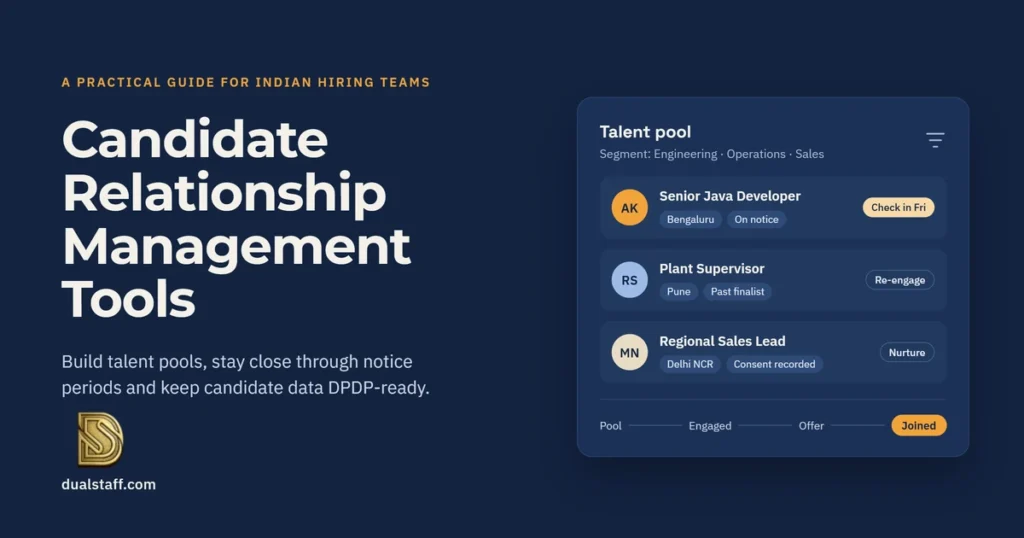
Candidate relationship management tools help hiring teams stay in touch with good candidates before a job opens, and long after one closes. Instead of starting every search from scratch, you build a warm talent pool of people who already know your company.
As a recruitment and staffing firm working across India, we see the same pattern often: companies lose strong candidates not at the interview stage, but in the quiet weeks before and after an offer. This guide explains what candidate CRM tools do, how they differ from an applicant tracking system, which features matter most in India, and how to keep the relationship strong all the way to a new hire’s first payslip.
Key Takeaways
- Candidate relationship management tools help recruiters build and nurture talent pools over months or years, not just for one opening.
- A candidate CRM manages relationships before and beyond an application; an applicant tracking system (ATS) manages applications for a specific job.
- In India, long notice periods and WhatsApp-first communication make ongoing candidate engagement especially important.
- Candidate data is personal data under the DPDP Act, 2023, so consent records and data controls are now essential features.
- The relationship should continue after the offer. A smooth handoff into an HRMS for onboarding and payroll protects the goodwill built during hiring.
Quick Answer
Candidate relationship management (CRM) tools are software that stores candidate profiles, tracks every interaction, and helps recruiters nurture relationships with potential hires over time. For Indian hiring teams, the most useful tools combine talent-pool segmentation, multi-channel messaging including WhatsApp, follow-up reminders through the notice period, and clear consent records under the DPDP Act, 2023.
What Are Candidate Relationship Management Tools?
Candidate relationship management tools are systems for finding, organising and engaging potential candidates over months or years, not just for one opening. They keep profiles, notes and conversation history in one place, so any recruiter can pick up a relationship where a colleague left it.
The idea comes from sales. Sales teams use a customer CRM to nurture leads until they are ready to buy. Recruiters use a candidate CRM, sometimes called a recruitment CRM, to nurture talent until they are ready to move.
These tools are especially useful for engaging passive candidates: people who are not actively job hunting but would consider the right opportunity.
How Is a Candidate CRM Different From an ATS?
An applicant tracking system (ATS) is software that manages people who have applied for a specific open job, from screening to offer. A candidate CRM manages relationships with people before and beyond any single application. Growing companies usually need both, and many modern platforms combine them.
| Candidate CRM | Applicant tracking system (ATS) | |
|---|---|---|
| Main job | Build and nurture talent pools | Manage applications for open roles |
| Who is in it | Passive and past candidates, referrals, event leads | Active applicants |
| Timeline | Months or years | Weeks, per opening |
| Typical actions | Tagging, segmenting, regular updates | Screening, interviews, offers |
With only an ATS, a strong finalist who narrowly missed an offer is usually forgotten once the role closes. A CRM keeps that person visible and contactable for the next suitable opening.
Why Do Candidate Relationships Matter More in Indian Hiring?
Several features of the Indian job market make relationship-led hiring especially valuable.
Long notice periods. A notice period is the time an employee must serve at their current company after resigning. In India, notice periods are often longer than in many other markets, so a selected candidate stays exposed to counter-offers and competing offers for weeks before joining.
Offer drop-offs. Because of that long gap, some candidates accept an offer and later back out. Regular, genuine contact between offer and joining helps recruiters spot doubts early.
Volume and campus hiring. Companies hiring in batches for operations, sales, support or fresher roles need to keep large groups of candidates informed without manual follow-ups. This is also where many companies bring in a recruitment partner for high-volume and contract staffing across industries.
WhatsApp-first communication. Many Indian candidates respond faster on WhatsApp than on email. If these chats stay on recruiters’ personal phones, the relationship history is lost when a recruiter moves on.
What Features Should Candidate Relationship Management Tools Have?
The best candidate relationship management tools make it easy to build talent pools, segment them, and contact the right people at the right time without losing track of anything.
| Feature | Why it matters for Indian hiring |
|---|---|
| Central candidate database | One record per candidate, so no recruiter starts from zero |
| Tagging and segmentation | Group by skill, city, experience, notice period or past stage reached |
| Multi-channel messaging | Email, SMS and WhatsApp, with every message logged to the profile |
| Talent pipelines | See who is ready to approach when a recurring role opens |
| Follow-up reminders | Keep regular contact through long notice periods |
| ATS integration | Move candidates from a talent pool into an active application smoothly |
| Consent records | Show how and when each candidate agreed to be contacted |
| Source and pipeline reports | Learn which sources produce hires and where candidates drop off |
If you are comparing tools, the last two rows deserve extra attention in India right now. Consent records matter because of the DPDP Act, and reporting shows whether your candidate engagement is actually producing hires.
How to Choose Candidate Relationship Management Tools: Questions to Ask Vendors
Choose candidate relationship management tools by testing them against your real hiring patterns, not a generic demo. Ask each vendor these questions before you shortlist:
- Messaging: Can recruiters message candidates on WhatsApp from the tool, and is every conversation logged to the candidate’s profile?
- Segmentation: Can we tag candidates by city, skill, notice period and the stage they reached last time?
- ATS connection: Does the CRM work with our current ATS, or replace it?
- Consent and data: How does the tool record consent, and where is candidate data stored?
- Handoff to HR: When a candidate joins, how do their details move into our HR system without re-typing?
- Pricing: Is pricing per recruiter, per candidate record or per message, and what happens as our database grows?
Bring a real example to the demo. Ask the vendor to show how they would re-engage last year’s finalists for a role you are hiring for again.
How Do You Build a Candidate Relationship Strategy?
A tool only works if there is a clear process behind it. This is the approach we recommend to the companies we hire for, and it works for in-house teams too.
- List your recurring roles. Talent pool management pays off most for positions you hire for again and again.
- Start with people you already know. Past finalists, strong applicants for closed roles, referrals and former employees make the warmest first pool.
- Segment before you message. A Java developer in Bengaluru and a plant supervisor in Pune need different updates. Generic mass messages quickly get ignored.
- Give candidates a reason to stay in touch. Share matching openings, company news or useful content about their field.
- Stay close during the notice period. After an offer is accepted, plan personal check-ins until the joining date. Introduce the future manager early where you can.
- Keep your data clean. Remove candidates who ask not to be contacted, and update profiles when people change roles.
How Does the DPDP Act Affect Candidate Data?
The Digital Personal Data Protection Act, 2023 (DPDP Act) is India’s law governing how organisations collect and use personal data. Candidate relationship management tools hold exactly this kind of data: contact details, employment history, salary expectations and notes from conversations.
The Ministry of Electronics and Information Technology (MeitY) notified the DPDP Rules, 2025 on 13 November 2025. Most of the substantive obligations for businesses come into force in phases, with the main compliance deadline in May 2027.
For recruitment teams, sensible steps are clear even now:
- Collect only the candidate data you genuinely need.
- Record how each candidate agreed to be contacted, and for what purpose.
- Make it easy for candidates to ask for their data to be corrected or deleted.
- Ask every CRM vendor where data is stored and who can access it.
This is not legal advice. Check your specific obligations with a qualified data protection advisor.
Handling data well is also good relationship management. Candidates notice when a company respects their privacy.
What Mistakes Should Hiring Teams Avoid?
Treating the CRM as a resume dump. A database of untagged, outdated profiles is not a talent pool. Without segmentation and regular updates, it delivers little value.
Messaging too often or too generically. Frequent blasts about unrelated roles train candidates to ignore you. Fewer, more relevant messages work better.
Going silent after the offer. The period between offer acceptance and joining is when many drop-offs happen. Silence during this window is a real risk.
Running disconnected systems. When the CRM, ATS and HR system do not share data, details get re-entered by hand and new joiners repeat information they have already given.
What Happens After the Candidate Says Yes? From CRM to HRMS
Our job as recruiters ends when a candidate joins, but the candidate’s experience does not. Their first impression as an employee depends on how smoothly they are onboarded.
If a candidate who enjoyed a personal, well-organised hiring process then faces paper forms, missing documents and a delayed first salary, much of that goodwill is lost. That is why we encourage the companies we work with to plan their HR system alongside their hiring tools.
An HRMS (human resource management system) is software that manages employee records and HR processes after hiring. For growing Indian companies, ZFour HRMS, an HRMS built for Indian businesses, is one option worth considering. It brings onboarding, employee documents, attendance and leave into one cloud platform, with a mobile app for employees on Android and iOS.
ZFour HRMS also handles payroll with EPF, ESI and TDS compliance, which matters in a new joiner’s first month, when statutory registrations and the first salary need to be right.
When hiring and HR systems are planned together, a new hire’s first weeks feel as organised as their hiring process did.
Frequently Asked Questions
What are the best candidate relationship management tools for Indian companies?
The best candidate relationship management tools for Indian companies combine talent-pool segmentation, WhatsApp and email messaging, follow-up reminders through long notice periods, and consent records for the DPDP Act, 2023. The right choice also depends on whether you need a standalone CRM or one built into your applicant tracking system.
What is candidate relationship management in recruitment?
Candidate relationship management is the practice of building and maintaining relationships with potential candidates over time, not just when a role is open. It helps recruiters hire faster from a warm pool of people who already know the company.
Is a candidate CRM the same as an ATS?
No. An ATS manages applicants for specific open jobs, while a candidate CRM manages longer-term relationships with passive and past candidates. Many teams use both, or a platform that combines them.
Why do candidates drop out after accepting an offer in India?
Long notice periods give candidates time to receive counter-offers or competing offers before joining. Regular, personal contact between offer and joining helps recruiters spot and address doubts early.
Can recruiters use WhatsApp with a candidate CRM?
Some candidate CRM tools support WhatsApp messaging alongside email and SMS. Logging these conversations in the CRM keeps the relationship history with the company rather than on one recruiter’s phone.
Does the DPDP Act apply to candidate data?
Yes. Candidate details such as contact information and employment history are personal data under the DPDP Act, 2023. Recruiters should collect only what they need, record consent, and let candidates update or delete their data.
What should happen after a candidate accepts an offer?
Recruiters should stay in regular, personal contact until the joining date. Once the candidate joins, their details should move smoothly into the company’s HRMS for onboarding, documents and payroll, so they do not repeat information they already shared.
Next Step: Audit Your Talent Pool This Week
Candidate relationship management tools help Indian hiring teams stop starting from scratch every time a role opens. Used well, they turn past applicants, referrals and passive talent into a pool you can hire from faster.
A practical first step is to review your current candidate database. Count how many profiles are tagged, how many have consent recorded, and how many were contacted in the last six months. Those three numbers will show you where to start.
If you need help building a talent pipeline or filling roles at scale, talk to DualStaff about permanent staffing, contract staffing, executive search and RPO across India.
About DualStaff
DualStaff Solution Services is a New Delhi-based recruitment and staffing company that helps businesses across India hire qualified professionals. Its services include permanent staffing, contract staffing, executive search, recruitment process outsourcing (RPO) and HR consulting.